
Wash painting Technique
Below is a brief description of the method used to create a wash painting.
Wash painting is a traditional painting technique that originated in Japan and is executed using water-based pigments, primarily watercolours. In India, this method was first introduced and developed by the eminent artist and Shilpa Guru Abanindranath Tagore, who played a pivotal role in adapting the technique within the Indian art context.Unlike conventional transparent watercolour painting, wash painting is a layered and time-intensive process. The technique involves the controlled use of both transparent and opaque applications of colour. After the pigments are applied, selected areas are deliberately washed with clean water to remove excess colour. This process softens forms, refines tonal values, and creates subtle gradations that are characteristic of wash painting.The intentional removal of pigment distinguishes wash painting from standard watercolour methods, where colours are typically preserved rather than lifted. This unique interaction between pigment and water allows for atmospheric depth, expressive nuance, and a harmonious balance between precision and fluidity.Because of its refined aesthetic and distinctive methodology, wash painting occupies a significant position in both Eastern and Indian art traditions. The technique continues to be valued for its ability to convey mood, delicacy, and narrative sensitivity.The following section outlines the step-by-step process involved in creating a wash painting.
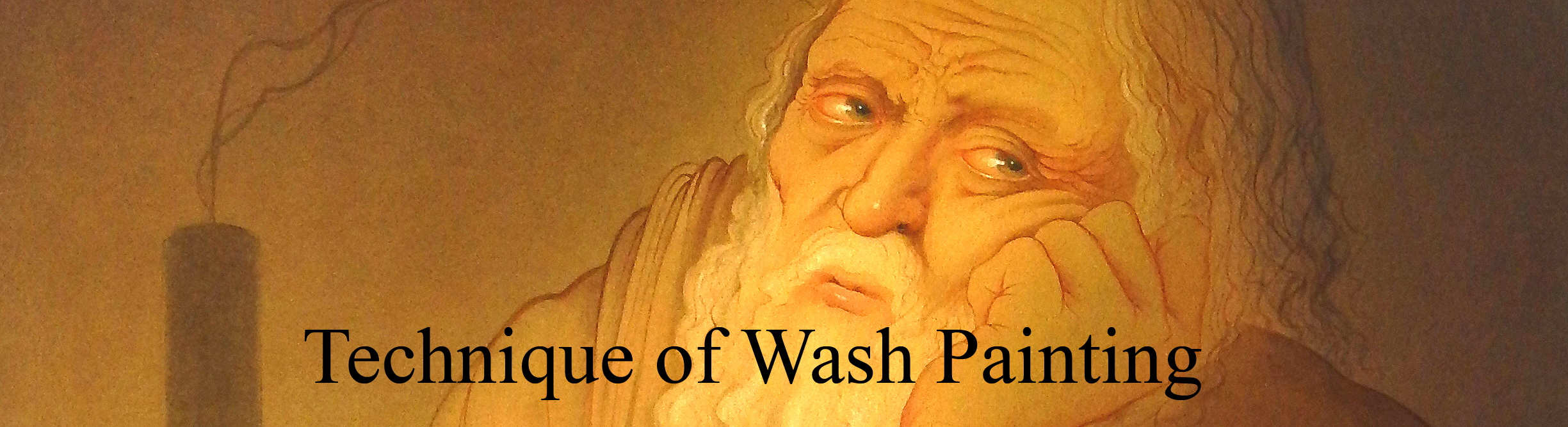
A wash painting is completed through a series of carefully executed steps.
Step 1: Preparing the Drawing
It is advisable not to draw directly on wash paper, as erasing pencil marks can damage the surface. Instead, the composition is first drawn on a separate sheet of light paper. Red oxide is then evenly rubbed onto the reverse side of this layout.The prepared layout is placed over the wash paper, and the lines are traced with light pressure using a pen without ink. This process transfers the impression onto the wash paper, ensuring the drawing is accurately placed without harming the surface. The wash paper is now ready for painting.
Step 2: Stretching the Paper and Initial Colour Application
In this step, clean water is evenly applied to the reverse side of the wash paper using a flat brush. The paper is then carefully placed onto a waterproof board, ensuring that no air bubbles remain beneath the surface. If bubbles appear, the paper should be gently lifted and repositioned until it lies flat.Once secured, painting begins with a light base wash. The subject is carefully observed, appropriate colours are selected, and the initial layers are applied within the drawing. The painting is developed gradually over several days. Depending on the subject, a transparent light wash may be applied over the entire surface or specific areas to build tonal harmony. This process is continued until the desired colour depth is achieved.
( Note: At the beginning of each working session, the wash paper should again be moistened on the reverse side and placed on the waterproof board before painting begins. Occasional washing with clean water may also be required, as explained in Step 3. )
Step 3: Washing with Water and Colour Fixing
As successive layers of colour are applied, excess pigment may accumulate. To regulate tonal intensity, the painting is washed with clean water. The wash paper is first secured to the waterproof board as usual, after which the board is positioned upright.Clean water is gently poured over the painting, and a flat brush is used with light vertical and horizontal strokes to loosen and lift excess colour. The surface is then rinsed again with clean water. This controlled washing process removes surplus pigment while preserving the underlying forms and tonal balance.
Step 4: Opaque Wash and Softening
In this stage, one or more washes of thick, opaque colour are applied, selected according to the requirements of the composition. After the application, the painting is allowed to dry completely and is then gently washed with fresh water. This process softens the surface, harmonizes the tones, and gives the painting a smooth and refined finish.
Step 5: Finishing Touches
This is the final stage of the wash painting process. White colour is applied where required to enhance highlights and define light and shadow using a fine brush. These final details refine the form and visual clarity of the composition. Once the finishing touches are completed, the painting must not be washed with water.
Understand each step thoroughly and refine your skills through consistent practice. If you encounter any difficulties while working with wash painting, feel free to contact me. I will be glad to offer guidance and support.
Rajib Gain__________